VoxMed respiratory screening workflow illustration
  • AI Research
  • Healthcare
  • Product Design
  • Human-AI Interaction
  • 2024

VoxMed

Designed a one-step clinical workflow for AI-assisted respiratory screening.

Timeline

Jan – Jul 2024

Team

5 Researchers

Role

Researcher, Product Designer, Frontend Engineer

Skills

Research, Human-Centered AI, Healthcare UX, Product Design, Frontend Development

Long story short

VoxMed was accepted at Interspeech 2024. I also co-authored ASGIR, a companion research paper on bird vocalization classification.

I co-authored VoxMed, a one-step respiratory disease screening system that combines AI with digital stethoscope recordings to detect respiratory diseases within seconds.

While the research focused on building an accurate audio classification model, my role was to bridge the gap between machine learning and clinical usability by translating complex AI outputs into an interface healthcare professionals could use with minimal training.

VoxMed research and product walkthrough

Problem

Slow diagnosis created an opportunity for fast screening

  • Respiratory diseases remain one of the leading causes of hospitalization worldwide.
  • Yet diagnosing them often requires multiple tests, specialist interpretation, and long waiting periods before treatment can begin.
  • We wondered whether medical audio alone could provide doctors with a fast first assessment before traditional diagnostic workflows.
Delhiites lose nearly 12 years of their lives to air pollution

Hypothesis

We tested whether one audio interaction could support clinical screening

Can AI accurately detect respiratory diseases from digital stethoscope recordings while remaining simple enough for real clinical workflows?

Instead of designing another medical dashboard, we focused on reducing the diagnostic journey into a single interaction.

Discovery

Medical audio contains patterns clinicians cannot always hear

  • Every respiratory condition produces subtle acoustic signatures.
  • By transforming lung sounds into machine-understandable representations, modern deep learning models can identify patterns beyond traditional auscultation.
  • The challenge was to make the workflow usable inside hospitals.

Solution

I reduced the clinical workflow to three steps

Most AI healthcare research stops at reporting model accuracy. But went a step ahead, real time clinical diagnosis.

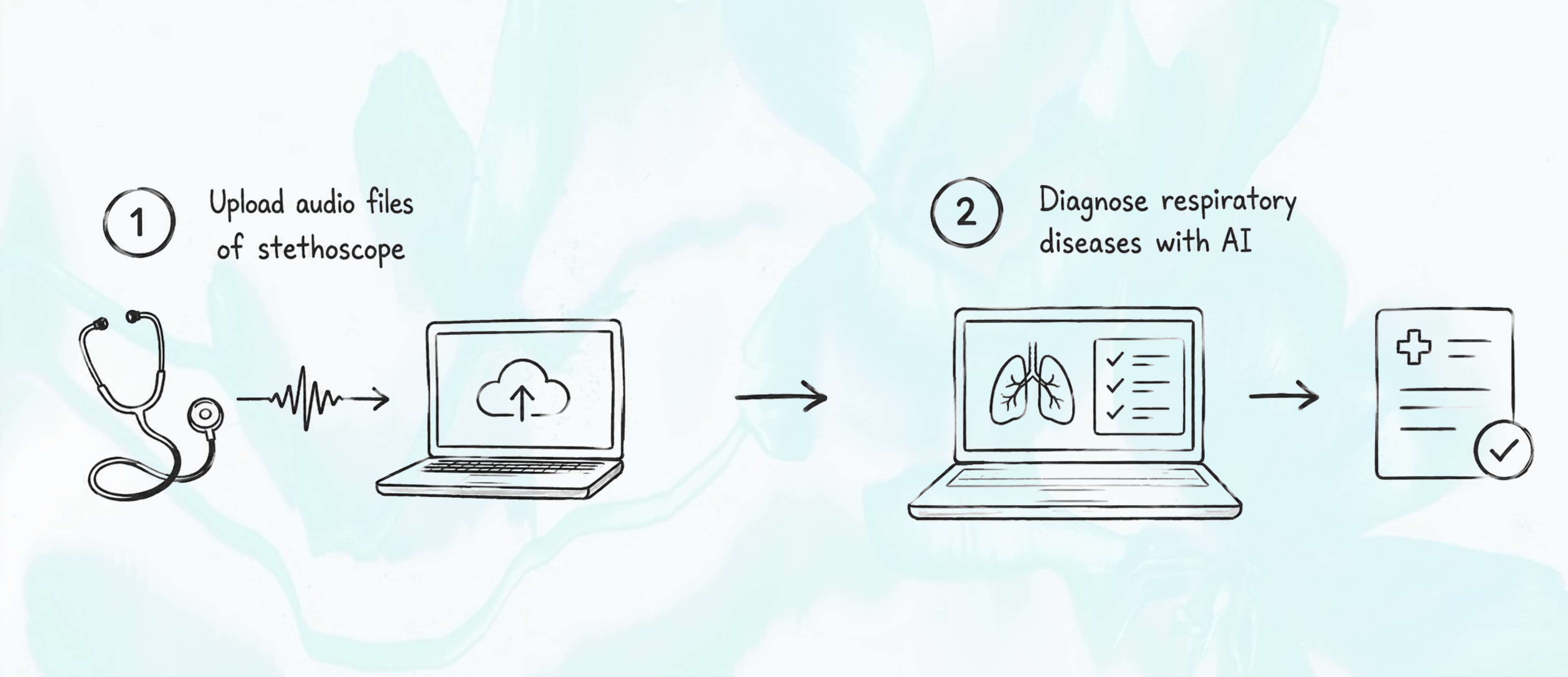
Our goal was to reduce the entire experience to three simple steps:

  • Record the patient's lung sounds.
  • Upload the recording.
  • Receive an interpretable diagnosis within seconds.

Design

The architecture translated lung sounds into an interpretable result

Behind the interface, the pipeline consisted of:

  • Digital stethoscope recordings
  • Audio Spectrogram Transformer (AST) for feature extraction
  • 1-D CNN for respiratory disease classification
  • Clinical interface presenting diagnosis and supporting information

This architecture allowed the system to classify multiple respiratory diseases from a single recording.
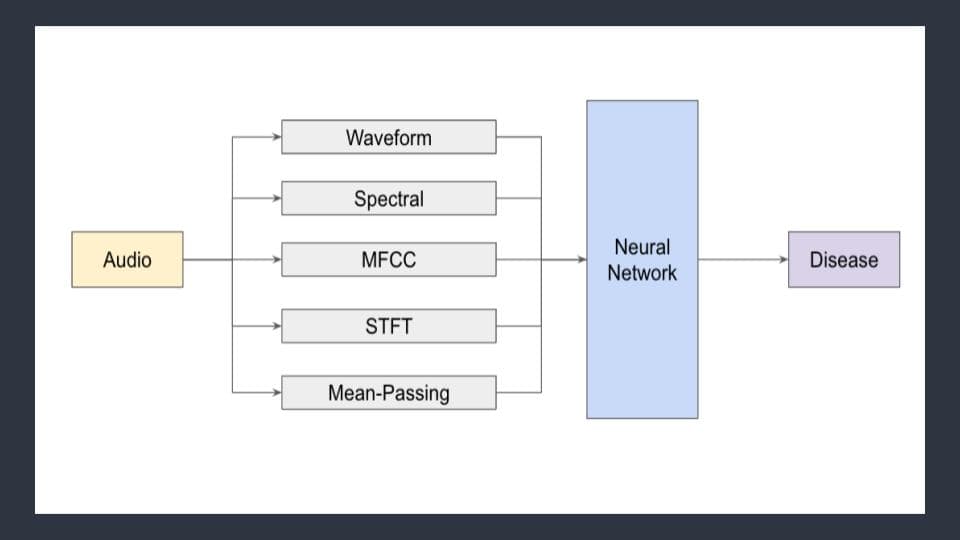
Architecture Diagram

Workflow

I designed the handoff between clinician and AI

Problem

Most AI medical tools expect clinicians to understand complex visualizations. That increases cognitive load during diagnosis.

Solution

We designed a one-step interface that surfaces only clinically relevant information. The experience focused on confidence diagnosis and actionable next steps rather than technical model outputs.

ui screens

Evaluation

We evaluated model performance and clinical usefulness

  • We evaluated VoxMed using the ICBHI respiratory sound dataset consisting of nearly 7,000 annotated respiratory cycles from 126 patients.
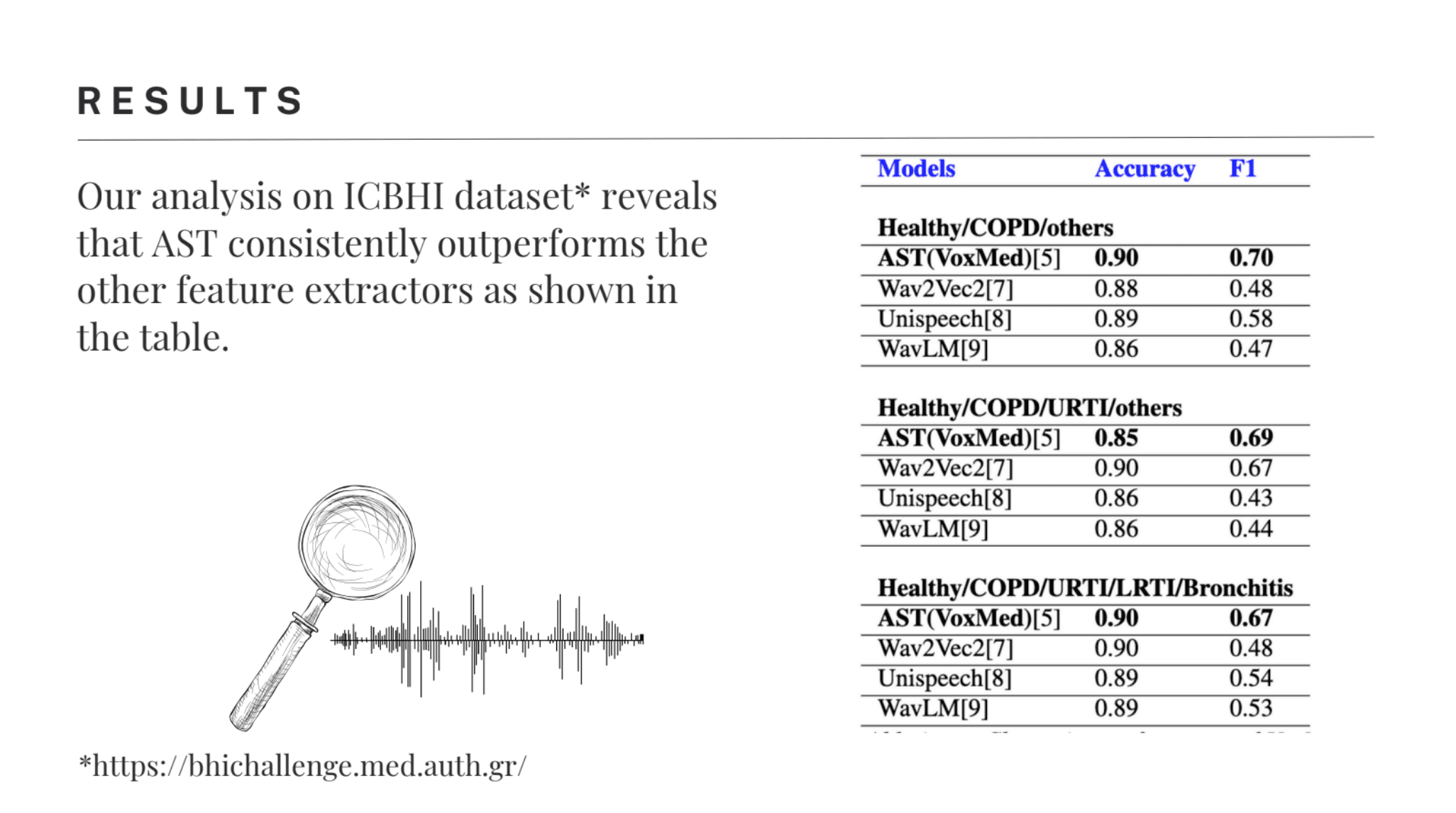
  • Across multiple backbone comparisons, the Audio Spectrogram Transformer consistently produced the strongest overall performance for respiratory disease classification.
VoxMed AST performance comparison table on ICBHI dataset
performance table

Contributions

I bridged research, product design, and frontend implementation

As part of the research team, I focused on making the research usable. Specifically, I:

  • Conducted opportunity research around respiratory diagnostics.
  • Designed the end-to-end clinical interface.
  • Built the frontend prototype.
  • Simplified the AI workflow into a one-step user experience.
  • Designed presentation and research communication materials.

Retrospective

What I would change

If I continued this research today, I would explore:

  • Explainable AI techniques to help clinicians understand why a diagnosis was predicted.
  • Prospective hospital studies with real clinicians rather than benchmark datasets.
  • Workflow integration with electronic medical record systems.
  • Calibration and uncertainty visualization for high-risk clinical decisions.

Learnings

What I took forward

  • Good AI disappears. The best machine learning systems let users focus on their own expertise.
  • Healthcare UX is about reducing cognitive load. Every additional interaction increases friction during diagnosis. The interface should disappear into the clinical workflow.
  • Research deserves product thinking. Translating novel models into tools that people can actually use is equally important.

Ready for next?